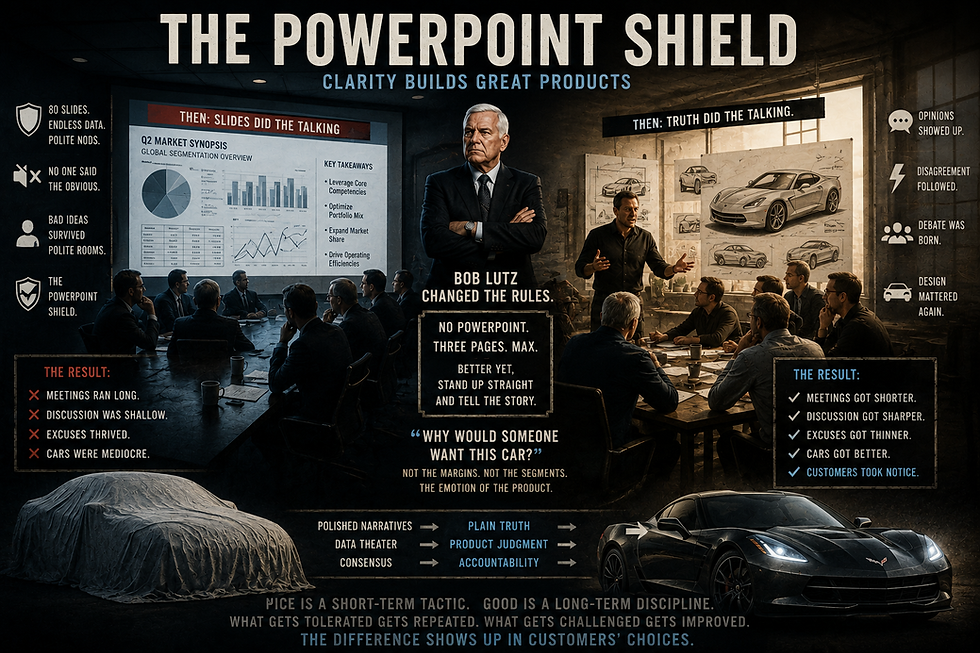
Why Lutz axed Powerpoint
In the early 2000s, Bob Lutz noticed something strange at General Motors.
The presentations were world-class. PowerPoint Perfect. (And this was before AI.) The cars were not.
Meetings ran on 80-slide decks. Market data. Cost curves. Focus groups. Everyone nodded. No one said the obvious. Which meant one thing: The slides were doing the talking. Not Reality.
Inside GM, this had a name without being named: The “PowerPoint shield.”
It let people sound smart without being clear. It let bad ideas survive polite rooms.
Lutz changed the rules: No PowerPoint.
If you wanted to pitch a car: Bring three pages. Max.
Or better yet, stand up straight and tell the story.
Why would someone want this car? Not the margins. Not the segments. The emotion of the product.
At first: Silence. Then Stumbling. Long pauses where slides used to be. People who could “present” couldn’t explain. Because explanations require belief.
Then something shifted.
Opinions showed up. Disagreement followed. Debate was born. Design mattered again.
You couldn’t hide behind bullet points. If the car was dull, someone said it. Out loud. From that point: Meetings got shorter. Discussion got sharper. Excuses got thinner
Nice avoids tension. Good uses it.
Some executives couldn’t operate without the shield. They faded. Others adapted. They grew.
The culture moved from:
Polished narratives → Plain truth.
Data theater → Product judgment.
Consensus → Accountability.
Lutz wasn’t anti-data. He was anti-hiding. He understood something simple: A slide deck can support your argument. It can’t build a great car.
Clarity isn’t comfortable. But neither is irrelevance.
Nice is a short-term tactic. Good is a long-term discipline.
What gets tolerated gets repeated. What gets challenged gets improved.
The difference shows up in customers' choices.