The Cost of Dysfunction
A day on local roads is instructive. Not the potholes (that’s another post). The gas prices. Or more precisely, the spread.
Gas stations don’t gouge. That’s settled. Prices move with global oil prices, and here in Michigan, about 70 cents per gallon goes to taxes.
The rest is local.
So, why the gap from city to suburb?
It isn’t the oil market.
It’s the business environment.
Costs are lower in the suburbs. Gas becomes cheaper.
In the city, costs stack up: Taxes, regulations, overhead — price follows. Residents pay more because they live and fuel up in high-cost neighborhoods.
They’re told density delivers efficiency. More services. Better outcomes. But at the pump, this math breaks. You pay more. You get less. Businesses raise prices to survive. Residents get squeezed twice: Once at the counter, again through the system meant to serve them.
This isn’t new.
It’s absorbed. Normalized. Not questioned.
A kind of learned helplessness, edging into normalization of deviance.
But there’s an opening here.
Imagine a city where government-driven costs aren’t higher than those of its neighbors. Where the baseline is competitive, not punitive.
That city grows. It holds. It absorbs shocks.
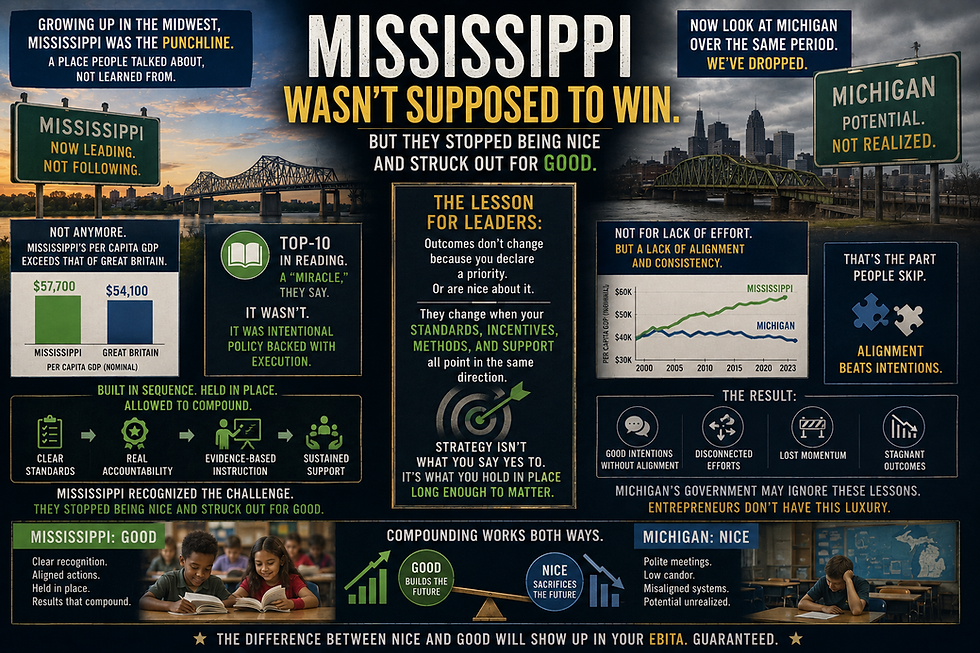
(Re)building Grand Rapids to thrive means abandoning “West Michigan nice” and moving towards Good. A city that excels at delivering more for less.
We can build it; it just requires leadership.